
EPS
Expandable polystyrene, supplied as impregnated beads that become closed-cell foam on your own moulding line. Bead size is the specification that matters most.
You buy beads, you make foam
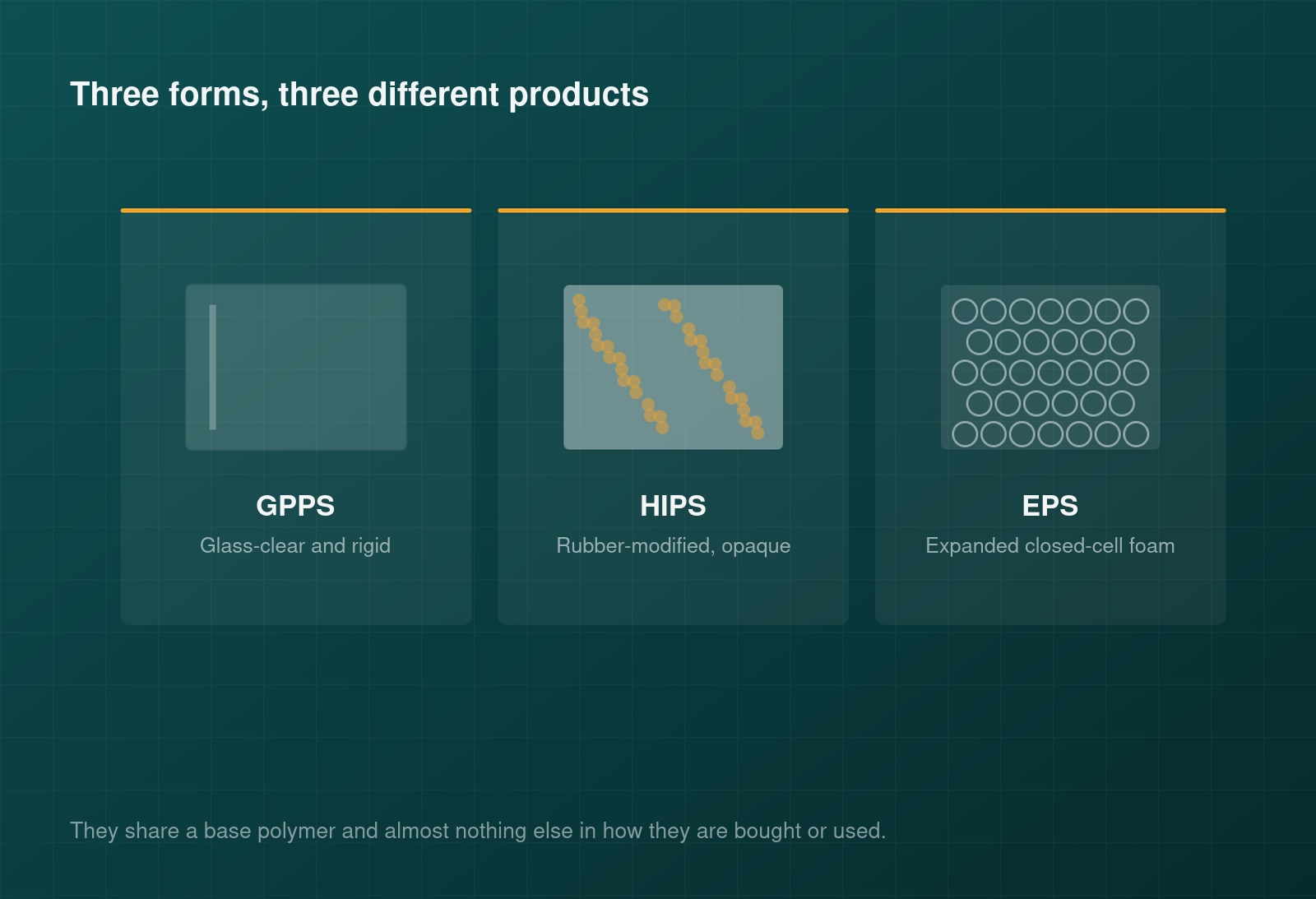
EPS arrives as small polystyrene beads impregnated with a blowing agent. Steam pre-expands them, they are aged, and then they are steam-moulded into a block or a shaped part. The finished foam is typically over ninety per cent air, which is where the insulation value and the low weight come from.
Bead size governs what the material can do. Fine beads reproduce detail and give a smooth surface for thin-wall packaging. Coarse beads expand into large, economical construction block. Choosing the wrong size costs either surface quality or density.
- Full bead-size range from fine packaging grades to coarse block.
- Flame-retardant grades for construction and insulation use.
- Cold-chain storage recommendations supplied with every consignment.
EPS grades we supply
13 grades are currently available. Availability moves with producer allocation, so confirm the grade with us before you commit a production slot.
- 121 HS
- 221 HS
- 321 HS
- F50
- F100
- F150
- F250
- F350
- F450
- F 1000
- F 2000
- F 3000
- F 4000
What decides the EPS grade
EPS selection is a balance between how fine the finished surface needs to be and how low the moulded density can go.
- Bead size: fine for detailed thin-wall packaging, coarse for construction block.
- Blowing agent content: governs achievable expansion ratio and minimum density.
- Flame retardancy: required for most construction and insulation applications.
- Moulded density target: the number that drives both cost and mechanical strength.
- Shelf life and storage: pentane content falls over time, so stock rotation matters.
Typical EPS applications
Two markets dominate EPS demand: protective packaging and building insulation. They pull the specification in opposite directions.
- Protective transit and appliance packaging
- Fish and produce cold-chain boxes
- Thin-wall moulded packaging inserts
- Helmet and safety liners
- Insulation board and construction block
- Void formers and lightweight fill
- Sandwich panel cores
- Decorative mouldings and formwork
Which EPS bead size suits your mould?
Tell us the wall thickness, the target density and whether the part needs flame retardancy. We will match a bead grade to it.