
Geotextile
Needle-punched nonwoven from 70 to 1000 GSM, in polypropylene and polyester. The layer that separates, filters, drains, protects and reinforces, often all at once.
Five jobs, and most projects need more than one
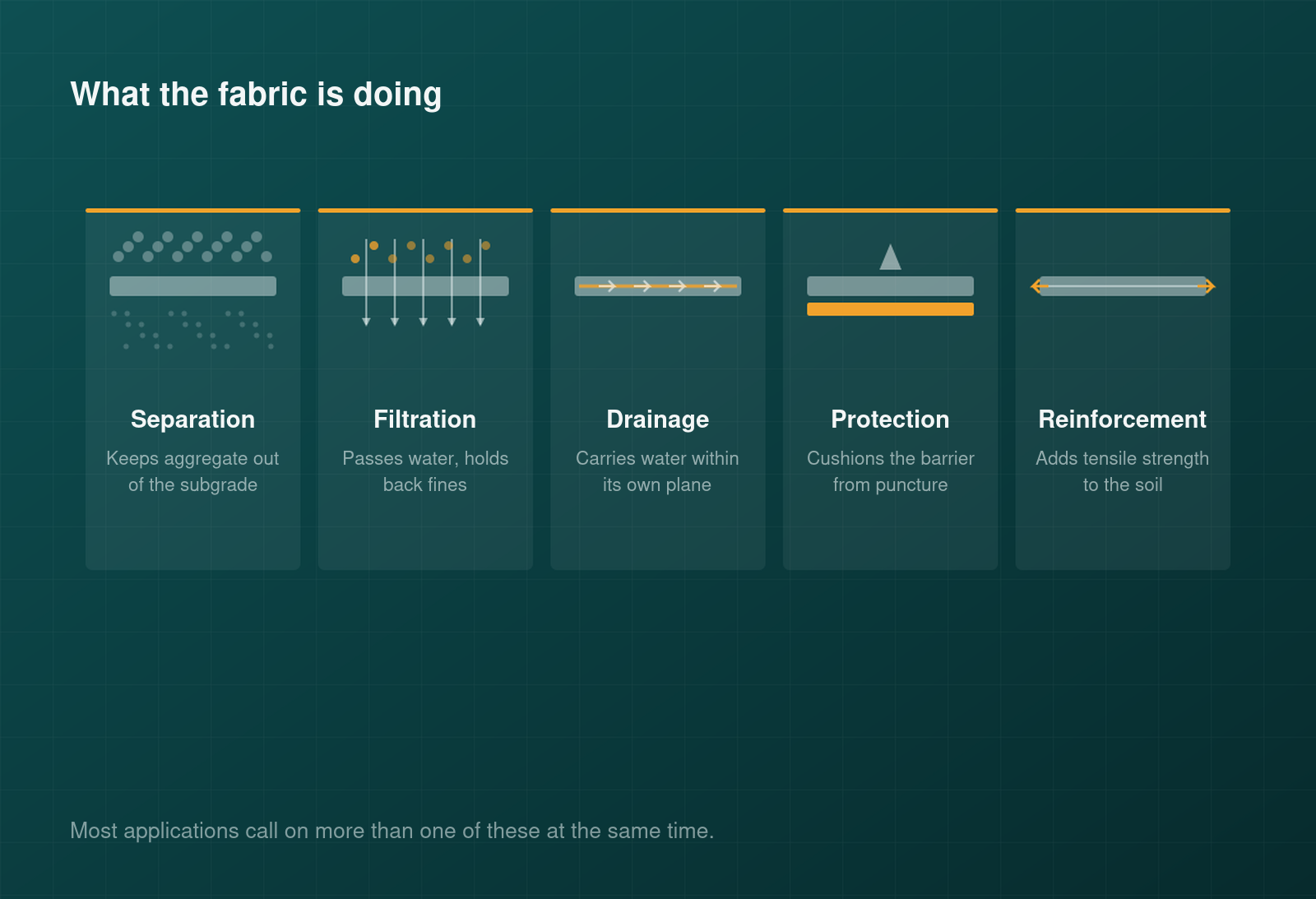
Geotextile is specified for five functions: separation, reinforcement, filtration, drainage and protection. Very few applications use only one. A road separator is also filtering fines out of the aggregate, and a geomembrane cushion is also draining the interface.
The weight in GSM is a proxy for all of it. Light fabrics separate and filter, heavy fabrics protect and reinforce. We produce from 100 per cent virgin polypropylene and polyester fibre by needle punching, because regenerated fibre gives inconsistent strength and shortens service life.
- Virgin PP and PET fibre only, no regenerated material.
- Weights from 70 GSM to 1000 GSM across both polymers.
- Roll widths from 2 m to 6 m, cut to order.
Geotextile types we supply
Polymer first, then weight. The function follows from both.
Polypropylene geotextile
The higher-volume option. Chemically inert across the normal pH range, resistant to most soil chemistry, and the usual choice for separation, filtration and drainage in roads, railways and landfill.
- 70 to 1000 GSM
- Excellent chemical inertness
- Roads, drainage, landfill
Polyester geotextile
Higher tensile modulus and lower creep than polypropylene, which is what reinforcement applications need when the load is permanent rather than transient.
- Higher modulus, lower creep
- Reinforcement applications
- Retaining structures and embankments
What the fabric does, and why it lasts
Features
- Needle-punched construction on 100 per cent virgin PP and PET fibre.
- Weight range from 70 GSM through to 1000 GSM.
- Roll widths from 2 m to 6 m, lengths 50 m to 200 m.
- High hydraulic conductivity with controlled pore opening size.
- UV, chemical and abrasion resistance.
- Custom weights and widths produced to order.
Advantages
- Separation without loss of drainage, unlike a compacted clay interface.
- High puncture and tear resistance for cushioning geomembrane.
- Filters fines while keeping water moving, which is what stops a drain silting.
- Reduces aggregate thickness needed over a weak subgrade.
- Fast to lay, with simple overlap or sewn joints.
- Long service life when buried and out of direct UV.
Geotextile ordering information
Standard production ranges. Tell us the function and the loading and we will recommend the weight rather than asking you to pick one.
Product
Needle-punched nonwoven geotextile
Raw material
Virgin polypropylene or polyester fibre
Manufacture
Needle punched
HS code
560394
Weight
70 GSM to 1000 GSM
Width
2 m to 6 m
Roll length
50 m to 200 m
Functions
Separation, reinforcement, filtration, drainage, protection
Minimum order
10,000 m²
Monthly capacity
50,000 m²
Packing
Wrapped rolls, palletised
Delivery terms
EXW, FOB, CFR, CPT
Where geotextile is used
Wherever two materials must stay apart but water must still move between them, and wherever a barrier layer needs protecting from what is above or below it.
- Road and railway subgrade separation
- Drainage trenches and French drains
- Geomembrane cushion and protection layers
- Landfill leachate collection blankets
- Asphalt overlay and reflective crack control
- Hard armour and rip-rap underlayment
- Embankment and retaining wall reinforcement
- Tunnel drainage and waterproofing systems
Not sure which weight you need?
Tell us the function, the subgrade, the aggregate above it and the loading. We will recommend a GSM and a polymer, with the data sheet attached.