
Geocomposite
Geotextile bonded to geomembrane, supplied as a single roll. One laying operation instead of two, and no risk of the cushion layer being skipped when the schedule tightens.
The protection layer cannot be forgotten if it is already attached
A geomembrane almost always needs a geotextile cushion against puncture from the subgrade or the cover material. On site those are two separate operations, and the second one is the one that gets rushed. A geocomposite removes that risk by bonding the two before they leave the factory.
It also shortens the programme. One roll, one crew pass, one set of seams. On large containment areas that difference is measured in weeks rather than days.
- Two-layer and three-layer builds to suit the exposure on each face.
- Polypropylene or polyester geotextile bonded to the barrier film.
- Produced to the membrane thickness and fabric weight you specify.
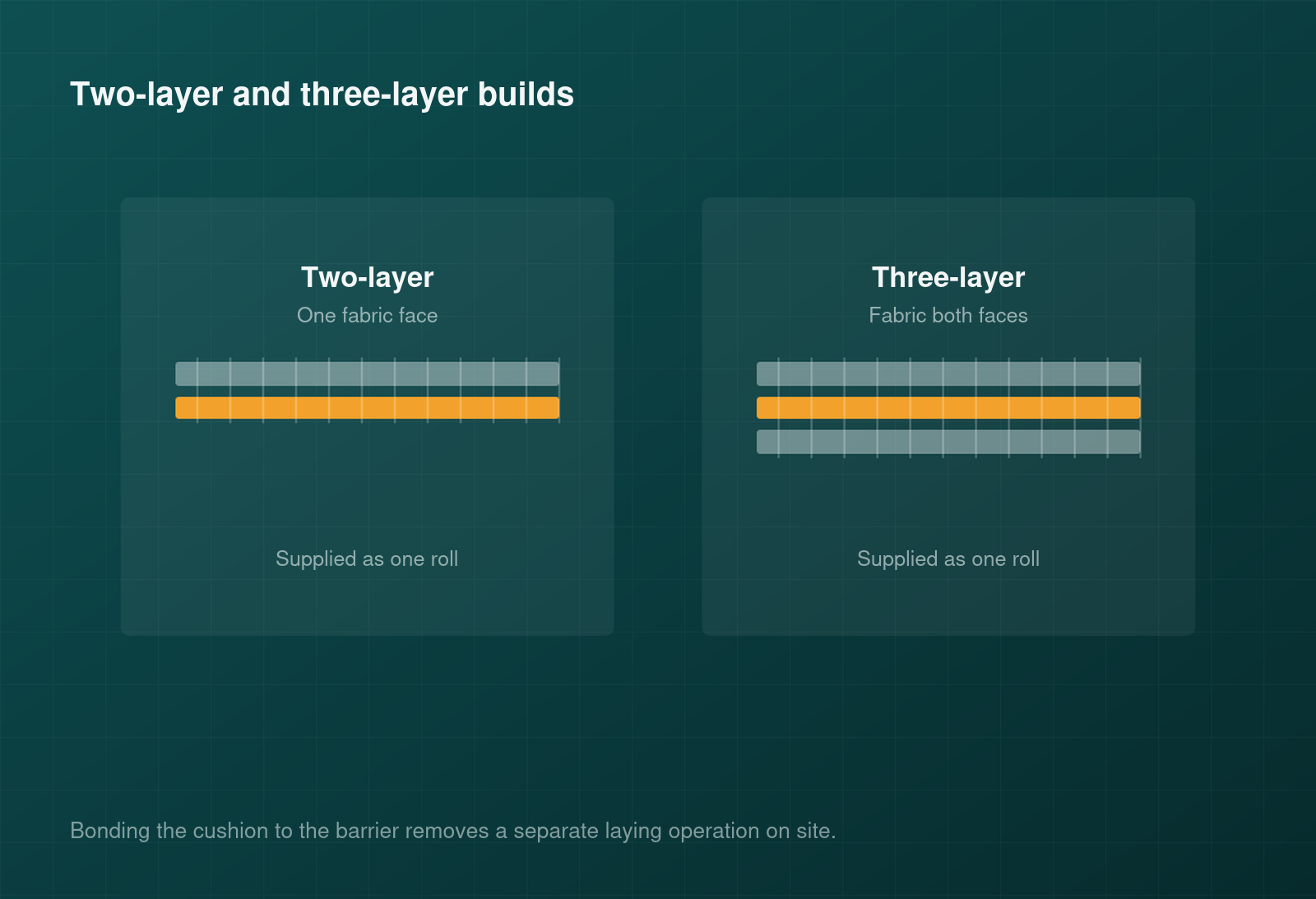
Geocomposite builds we supply
The number of fabric faces follows from what each side of the liner is against.
Two-layer geocomposite
One geotextile face bonded to one barrier film. Used where only one side needs protecting, typically against a prepared subgrade with the exposed face left clear.
- One fabric, one membrane
- PP or PET geotextile face
- Prepared subgrade applications
Three-layer geocomposite
Geotextile bonded to both faces of the barrier film, protecting against puncture from the subgrade below and the cover or ballast above.
- Two fabrics, one membrane
- Protection on both faces
- Cover soil and ballast applications
What the bonded build gives you
Features
- Geotextile bonded on one or both faces of the barrier film.
- Polypropylene or polyester fabric, specified by weight.
- High tensile, tear and puncture resistance as a single system.
- Barrier film thickness specified independently of the fabric.
- Produced to project width and roll length.
- Welded with the same equipment as a plain geomembrane.
Advantages
- One laying operation instead of two, cutting programme time.
- The cushion layer cannot be omitted or misaligned on site.
- Resistant to chemical and biological degradation in buried service.
- Good filterability where the fabric face doubles as a drainage layer.
- Fewer deliveries, fewer rolls to handle, less site storage.
- Long-term durability once covered.
Geocomposite ordering information
Built to order around the membrane and fabric you specify, so treat these as the working ranges rather than a fixed catalogue.
Product
Geotextile and geomembrane composite
Build
Two-layer (one fabric face) or three-layer (both faces)
Barrier film
HDPE or LLDPE, thickness to specification
Fabric
Needle-punched PP or PET, weight to specification
Width
To project requirement, typically 2 m to 6 m
Roll length
50 m to 200 m
Jointing
Wedge or extrusion welding on the barrier film
Minimum order
10,000 m²
Packing
Wrapped rolls, palletised
Delivery terms
EXW, FOB, CFR, CPT
Where geocomposite is installed
Anti-seepage work where the barrier also needs mechanical protection, which in practice means most buried containment.
- Water conservation and reservoir lining
- Canal and irrigation ditch sealing
- Subway and underground impermeable lining
- Road and railway subgrade sealing
- Construction cofferdams
- Landfill basins under heavy cover
- Tailings and process water ponds
- Tunnel waterproofing systems
Two-layer or three-layer?
Send us the subgrade condition and what goes on top of the liner. That answers the build, the fabric weight and the film thickness in one go.