Technical Support & Installation
Design, welding crews and QA documentation. The part of a containment contract that decides whether the material on the drawings ends up performing on the ground.
We would rather be responsible for the whole system
Supplying a roll of geomembrane is the easy half. The difficult half is the design of the lining system, the panel layout, the welding, the testing and the paperwork that proves it was done properly. Splitting those across two companies is how disputes start.
Our installation arm has been welding containment systems since the 1990s. We can supply material only, if that is what you want. But when we supply and install, there is one contract and one company answering for the result.
- One contract covering material, installation and documentation.
- Support from initial planning through delivery to commissioning.
- Round-the-clock contact during the works and after handover.
Technical support
What our engineers do before a roll is cut.
Technical consultation
Material selection against the exposure, the chemistry and the design life, with an honest note where the cheaper option carries real risk.
Lining system design
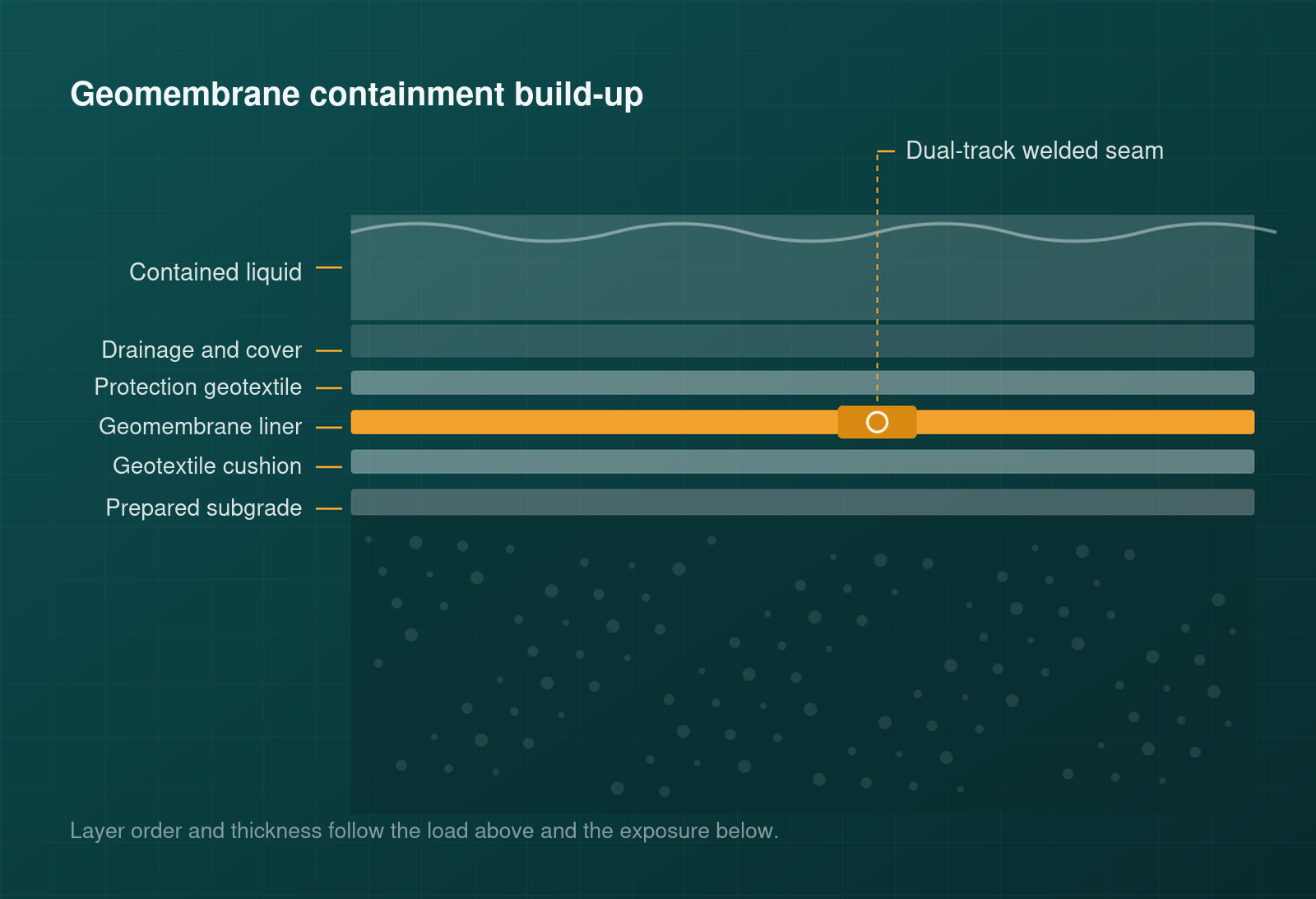
The full barrier build: primary liner, protection, drainage and any secondary containment, specified as one system rather than a parts list.
Layout plans
Panel layouts that minimise seam length, keep seams off the slope toe and give the crews a drawing they can actually work from.
Stability analysis
Interface friction and veneer stability checks on every slope, which is what decides smooth against textured sheet.
Installation advice
Subgrade preparation, anchor trench detailing, penetration and pipe boot design, and sequencing against the site programme.
In-situ monitoring
Planning and execution of monitoring during the works, so problems are found while the liner is still exposed.
Trained welding specialists
Our welders are trained on our own equipment and retrained on a schedule, not once at induction. Seam quality is the single largest variable in whether a lining system holds, and it is the one most often left to whoever was available that week.
Every seam is tested. Non-destructive testing across the full length, destructive samples at set intervals, and both recorded panel by panel.
- Wedge and extrusion welding crews, regularly retrained.
- Trial welds at the start of every shift and after any temperature change.
- Air pressure and vacuum box testing across full seam length.
- Destructive peel and shear samples at set intervals.
- Repairs logged, patched and retested before cover.
- Experience in conduit and sealing work dating to the 1990s.
Where we install
The systems our crews are set up to build.
Landfill solutions
Basin lining, leachate collection, capping systems and gas venting, sequenced around an operating site.
Tunnel solutions
Waterproofing membranes, drainage layers and compartmentalised sealing for underground structures.
Hydraulic solutions
Canals, reservoirs, dams and process ponds, including work in and around existing water.
Civil solutions
Road and rail subgrade sealing, reinforced soil structures and working platforms.
Groundwater protection
Barrier systems and secondary containment for sites where the aquifer below is the thing being protected.
Concrete corrosion protection
Liner systems bonded to concrete structures exposed to aggressive chemistry or sewage.
What you get at completion
QA and QC record
Panel-by-panel seam testing records, trial weld logs and repair register as a single documented set.
Material certification
Certificates of analysis and batch references for every roll that went into the works.
As-built drawings
Final panel layout as installed, with seam numbering that matches the test records.
Warranty
Ten-year material warranty, with installation covered under the same contract.
Have a project that needs installing, not just supplying?
Send us the drawings and the programme. We will come back with a lining specification, an installation method statement and a price for both.