
Geomembrane
The barrier layer. HDPE, LLDPE and polypropylene sheet from 0.5 mm to 3 mm, smooth or textured, welded on site by our own crews and tested seam by seam.
Thickness is a design decision, not a budget one
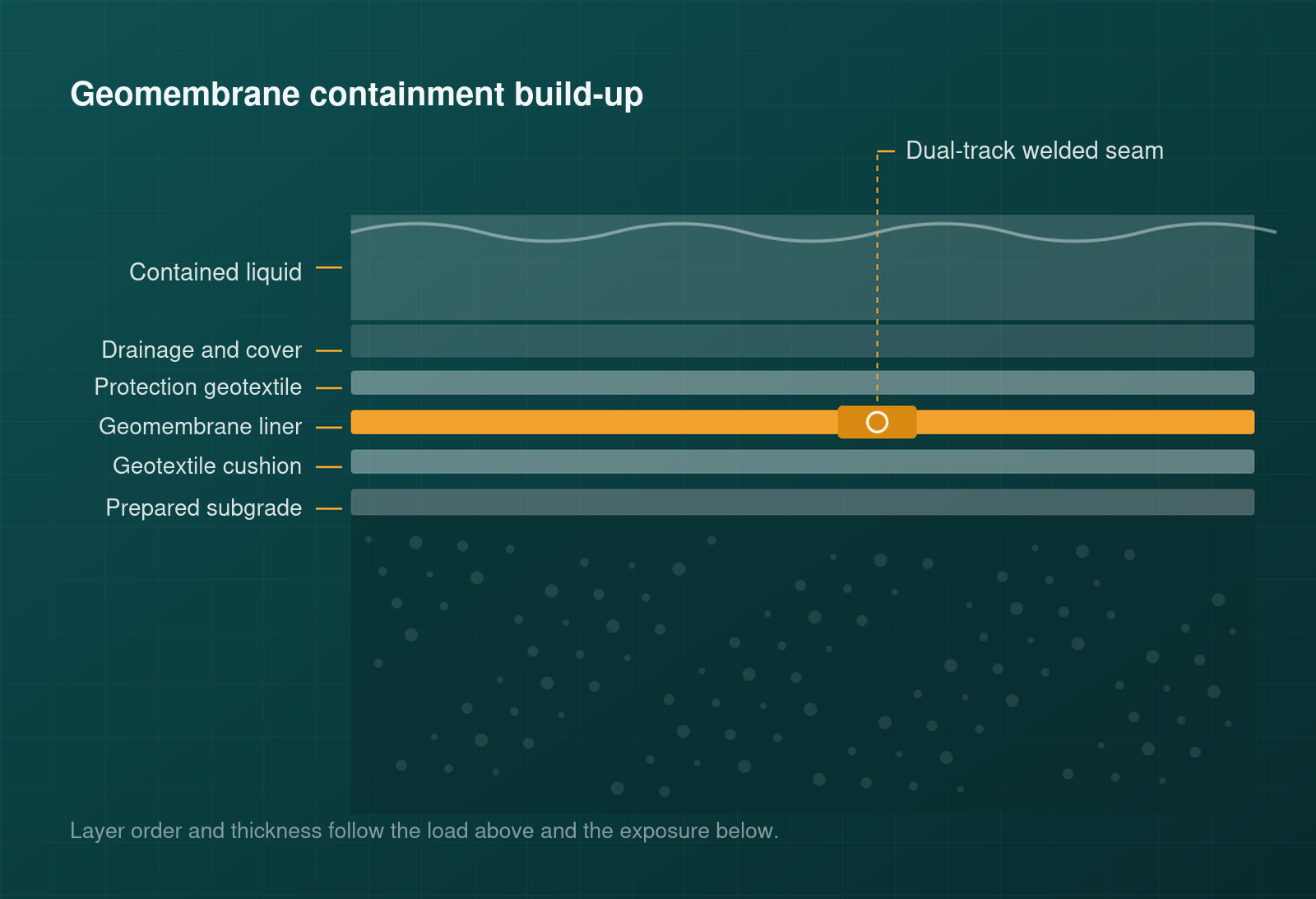
A geomembrane is specified by what sits on top of it and what it has to hold back. A pond liner under still water and a landfill basin under thirty metres of waste are the same product family and completely different specifications. Thickness, surface texture and polymer all follow from that load case.
HDPE gives the best chemical resistance and the highest strength, which is why it dominates landfill and mining. LLDPE trades some of that for flexibility, useful where the liner has to conform to an irregular subgrade or survive settlement. Textured surfaces exist for one reason: friction on slopes.
- Smooth, single-side textured, double-side textured and V-grid surfaces.
- Widths from 1.6 m as standard, up to 8.5 m on request.
- Ten-year material warranty, with laboratory confirmation per batch.
Geomembrane types we supply
Polymer first, then surface, then thickness. The order matters.
HDPE
High density polyethylene, the default for aggressive containment. Best chemical resistance, highest tensile strength, lowest permeability of the range.
- Landfill basins and caps
- Mining and heap leach pads
- 0.75 mm to 3 mm
LLDPE and VLDPE
More flexible than HDPE and far more forgiving of differential settlement or an uneven subgrade, at some cost in chemical resistance.
- Irregular subgrades
- Settlement-prone sites
- 0.5 mm to 2 mm
Polypropylene
PP and reinforced PP sheet, chosen where the liner must stay flexible at low temperature or be prefabricated into large panels.
- Reinforced and unreinforced
- Cold-weather flexibility
- Prefabricated panels
Textured
Single or double-side textured surfaces raising the interface friction angle so the liner and the cover soil stay on the slope.
- Single and double-side
- Slope and side-wall use
- V-grid option
Coloured
White-surfaced sheet to cut surface temperature and improve defect visibility during installation, and custom colours to order.
- White reflective surface
- Lower thermal expansion
- Custom colours to order
What the sheet does, and why that matters on site
Features
- Thickness from 0.5 mm to 3 mm across the polymer range.
- Widths from 1.6 m to 2.5 m as standard, to 8.5 m on request.
- Smooth, single-textured, double-textured and V-grid surfaces.
- Antioxidant and carbon black packages for long-term UV exposure.
- Production capacity above 10,000 tonnes a year.
- Every batch confirmed in the laboratory before release.
Advantages
- Wide service temperature range, including freeze-thaw exposure.
- Chemical resistance well beyond compacted clay alternatives.
- High tensile strength and elongation for seismic and settlement movement.
- Resists algae growth and root penetration.
- Straightforward to weld, patch and repair in place.
- Ten-year material warranty and a service life measured in decades.
Geomembrane ordering information
Standard commercial terms. Anything outside these ranges is usually possible, so ask before assuming it is not.
Product
HDPE / LLDPE / PP geomembrane
HS code
39201090
Thickness
0.5 mm to 3 mm
Width
1.60 m to 8.5 m
Roll length
50 m to 200 m
Surface
Smooth both sides, single-side textured, double-side textured, V-grid
UV resistance
High, carbon black and antioxidant package
Lead time
Three weeks maximum
Minimum order
10,000 m²
Monthly capacity
50,000 m²
Packing
Nylon-wrapped rolls on pallets
Delivery terms
EXW, FOB, CFR, CPT
Where geomembrane is installed
Anywhere a liquid has to stay on one side of a boundary. The exposure decides the polymer, the depth decides the thickness, and the slope decides the texture.
- Landfill basins, cells and capping systems
- Mining heap leach pads and tailings dams
- Reservoirs, canals and irrigation ponds
- Fish and shrimp farming ponds
- Tunnel and underground waterproofing
- Petrochemical secondary containment
- Road and railway subgrade sealing
- Golf course lakes and landscape features
Specifying a lining system?
Send us the containment volume, the material being contained, the slope angles and the subgrade. We will come back with a thickness, a polymer and a panel layout.