Film cost is measured per pallet, not per roll
The cheapest roll of stretch film is rarely the cheapest way to wrap a pallet. What matters is how many grams of film end up on each load, how much containment force that film delivers, and how many loads arrive without shifting. Machine film and hand film sit at very different points on that curve.
Hand film
Hand film is wound for manual application, usually on shorter cores and in narrower widths. It is the right answer for low throughput, mixed pallet shapes, awkward part-loads and anywhere a wrapping machine cannot be justified.
Its limitation is consistency. An operator applies somewhere between 10 and 40 percent stretch depending on fatigue and pace, so the film on the pallet is nowhere near the yield the resin can deliver, and containment force varies load to load.
Machine film
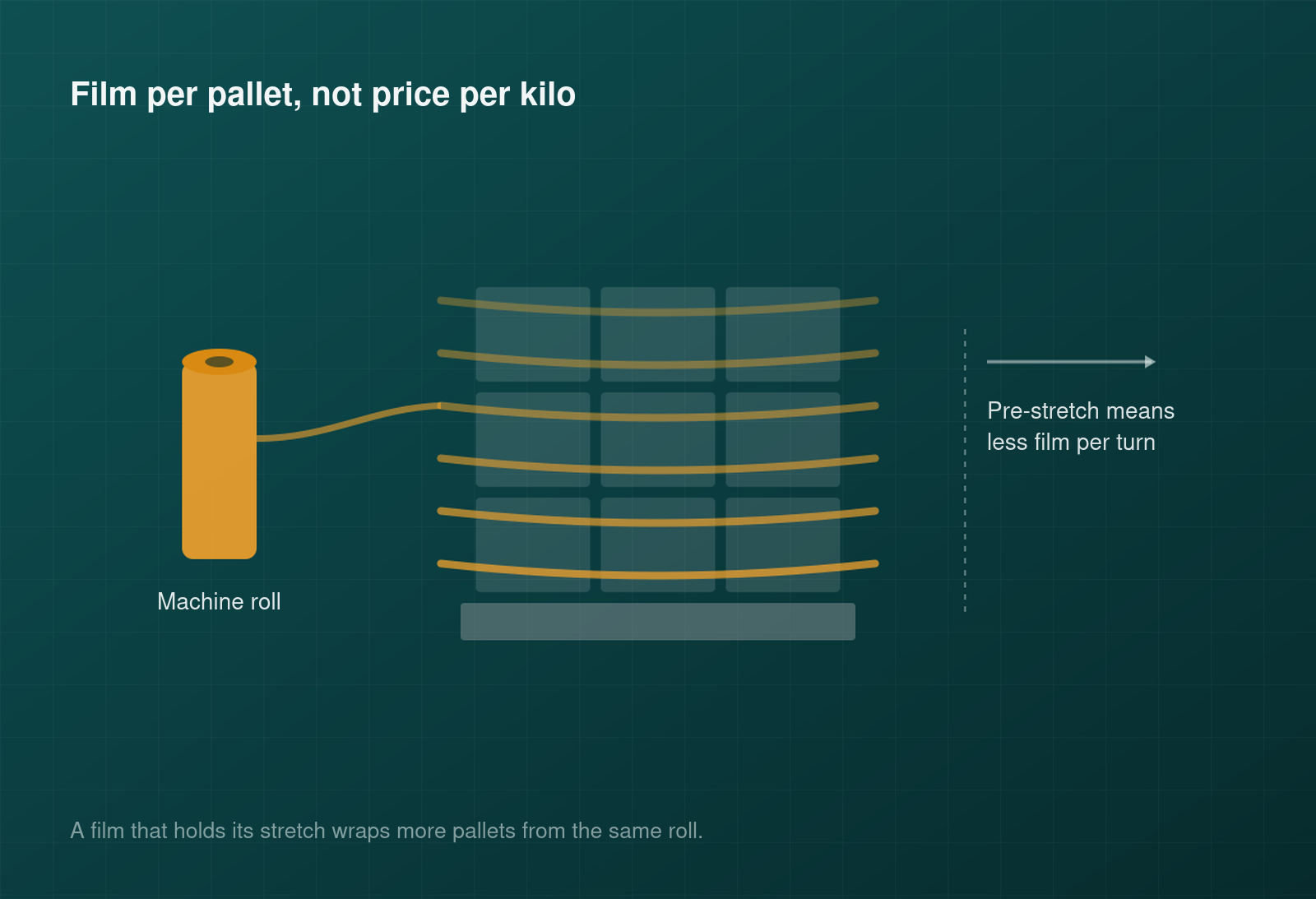
Machine film is engineered for powered pre-stretch. A turntable or ring wrapper can draw 150 to 300 percent stretch reliably, which means one kilogram of film covers two to four times the surface area it would by hand, at a higher and far more repeatable containment force.
The economics follow directly: film consumption per pallet drops sharply, wrap cycles are faster, and load-shift damage claims fall because every pallet leaves with the same wrap pattern.
Pre-stretch film as a middle path
Pre-stretch film is elongated during manufacture and supplied ready-stretched. It gives much of the yield benefit of machine film to an operation that still wraps by hand, at the cost of a thinner, less puncture-tolerant web.
What to check before switching
- Throughput — above roughly 30 to 50 pallets a day, a wrapper and machine film usually pay back inside a year.
- Load profile — sharp-edged or unstable loads may need a heavier gauge or a reinforced film rather than more wraps.
- Containment force — measure it on the finished pallet. It is the only number that correlates with transit damage.
- Gauge reduction — a higher-performance resin often allows a thinner film at the same containment, cutting both cost and packaging waste.
We supply machine, hand, pre-stretch, silage, coloured and heavy-duty films, and can run a film trial against your current wrap pattern to establish the real cost per pallet.