Start with the containment duty, not the price
HDPE and LLDPE geomembranes are both polyethylene liners, but they behave very differently once they are in the ground. Choosing between them is a question of what the liner has to survive: chemical attack, differential settlement, or both.
HDPE geomembrane
High-density polyethylene has the highest crystallinity of the two, which gives it superior chemical resistance, very low permeability and excellent UV durability. It is the default choice for landfill base and cap liners, leachate ponds, mining heap-leach pads and any application where aggressive liquids are contained for decades.
The trade-off is stiffness. HDPE has limited elongation before yield, so it is less forgiving of sharp subgrade or settlement. It also expands and contracts noticeably with temperature, which is why HDPE panels are installed with deliberate slack and welded in cooler parts of the day.
LLDPE geomembrane
Linear low-density polyethylene trades some chemical resistance for flexibility. Multi-axial elongation is far higher, so an LLDPE liner conforms to irregular subgrades and tolerates differential settlement without stressing the weld seams.
That makes it the better liner over compressible or uneven ground, on tight-radius detailing, and in closure caps built over waste masses that are still settling. VLDPE takes the same principle further where maximum conformance is required.
A short decision guide
- Aggressive chemistry, long service life, stable subgrade — HDPE.
- Settlement expected, irregular subgrade, complex detailing — LLDPE.
- Steep slopes — specify a textured surface on either resin to raise the interface friction angle.
- Exposed installations — confirm the carbon black content and the oxidative induction time, not just the thickness.
Thickness is a separate decision
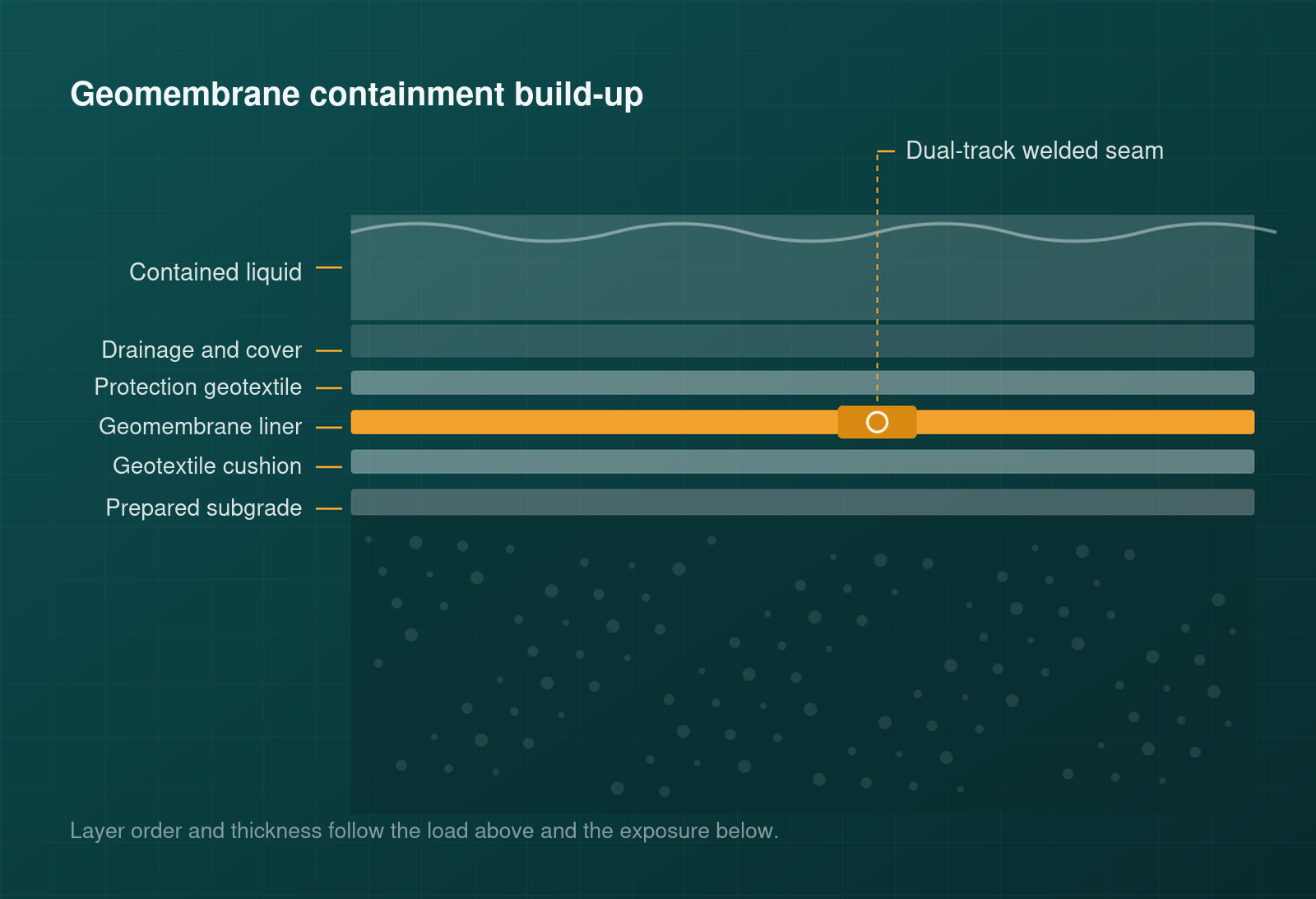
Resin choice and thickness are often confused. Thickness is driven by puncture risk, construction traffic and regulatory minimums; resin is driven by chemistry and strain. A 1.5 mm HDPE liner and a 1.5 mm LLDPE liner solve different problems.
Our technical team can review your subgrade report and containment chemistry and recommend a resin, thickness and surface finish before you go to tender.