
Geocell
Honeycomb confinement in HDPE and polypropylene, 50 mm to 200 mm deep. Ships folded flat, opens into a cellular mattress that stops infill moving sideways.
Confinement, not reinforcement
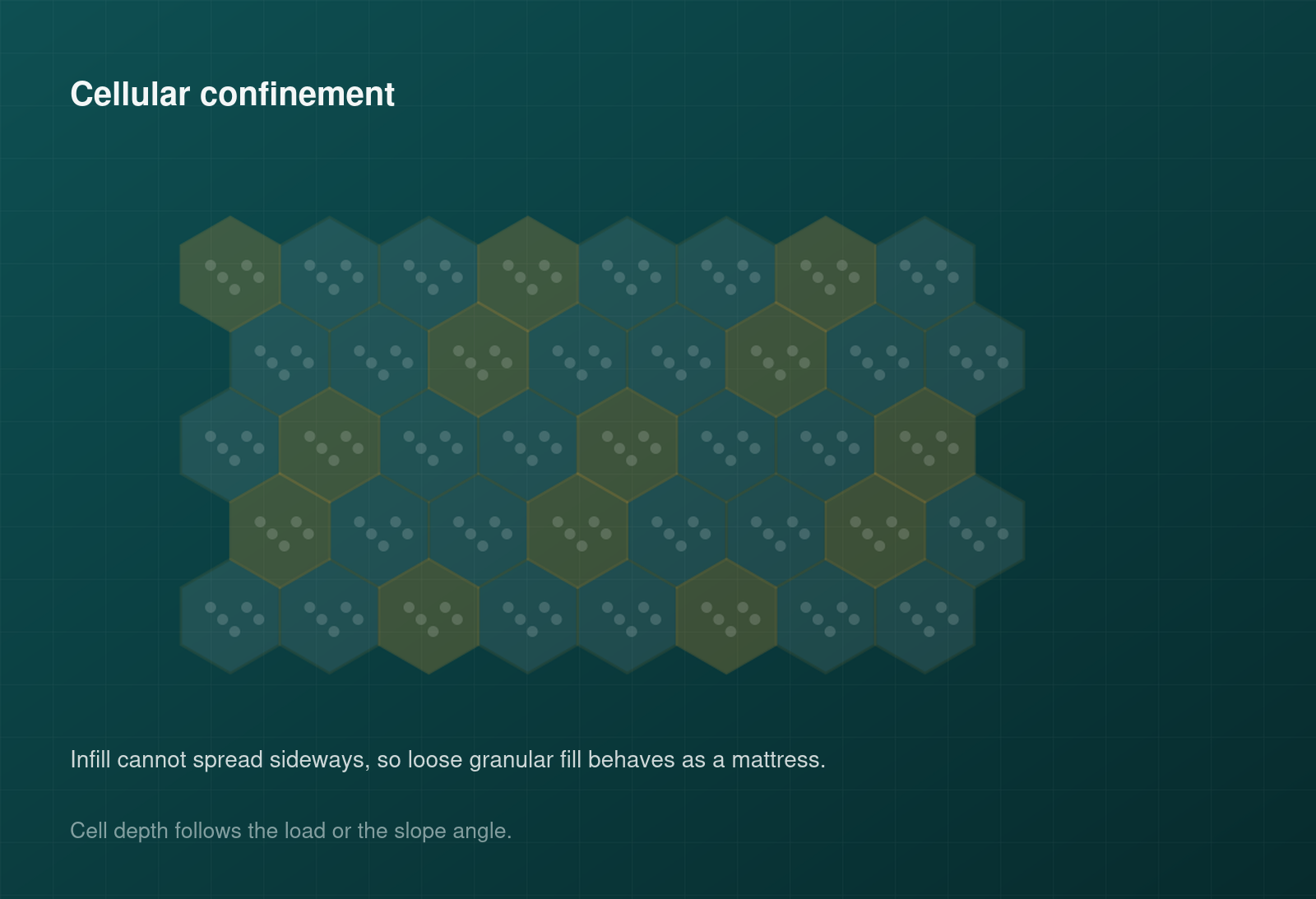
A geocell does something a geogrid cannot. Rather than interlocking with the aggregate, it physically encloses it in cells, so the infill cannot spread laterally under load at all. That turns loose granular fill into a semi-rigid mattress that spreads load far more effectively than its thickness suggests.
The same property makes it the standard answer for vegetated slopes. Soil held in cells stays on a gradient that would otherwise wash off in the first heavy rain, which is what lets planting establish on ground that could not previously support it.
- Folds flat for transport, which cuts freight cost significantly.
- Cell depths from 50 mm to 200 mm, diameters 220 mm to 350 mm.
- Perforated and textured strip options for drainage and friction.
Geocell types we supply
Both polymers cover the same depth range; the difference is stiffness and temperature behaviour.
HDPE geocell
The higher-stiffness option, holding cell shape under heavy static load. The usual choice for load support under roads, hardstandings and working platforms.
- Strip thickness 1 mm to 2 mm
- Load support applications
- Perforated and textured options
PP geocell
More flexible and more tolerant of low temperature without becoming brittle, which suits slope work and channel linings that must follow an irregular profile.
- Better cold flexibility
- Slope and channel work
- Conforms to irregular ground
What the cellular structure gives you
Features
- Strip thickness from 1 mm to 2 mm.
- Cell diameter from 220 mm to 350 mm.
- Cell depth from 50 mm to 200 mm.
- HDPE and polypropylene constructions.
- Perforated strip options for cross-cell drainage.
- Folds flat, so a full panel set ships in a fraction of the volume.
Advantages
- Stabilises and protects sloped surfaces that will not hold fill otherwise.
- Works with almost any infill, from topsoil to aggregate to concrete.
- Raises bearing capacity on weak ground without deep excavation.
- Protects channel and waterway linings from scour.
- Lets planting establish on gradients that would otherwise erode.
- Fast to open and pin, with no specialist plant.
Geocell ordering information
Standard production ranges. Cell depth follows the load or the slope angle, so send us those rather than picking a depth.
Product
Cellular confinement system
Raw material
HDPE or polypropylene
Strip thickness
1 mm to 2 mm
Cell diameter
220 mm to 350 mm
Cell depth
50 mm to 200 mm
Strip surface
Smooth, textured or perforated
Panel size
To project requirement
Transport
Supplied folded flat
Minimum order
By project, quoted on drawings
Delivery terms
EXW, FOB, CFR, CPT
Where geocell is installed
Two distinct jobs: holding soil on a gradient, and spreading load over ground that cannot take a point load.
- Vegetated slope erosion control
- Planted retaining structures
- Channel and waterway linings
- Riverbank and shoreline protection
- Access roads over soft ground
- Working platforms and hardstandings
- Load support under pavements
- Tree root protection and permeable parking
Stabilising a slope or a soft subgrade?
Send us the slope angle or the design load, plus the infill you intend to use. We will recommend a cell depth, a diameter and a panel layout.