
Geogrid
Soil reinforcement in six grid types, from 35×35 kN/m to 100×100 kN/m. The cheapest way to make weak ground carry a load it was never going to carry on its own.
Stiffness matters more than strength
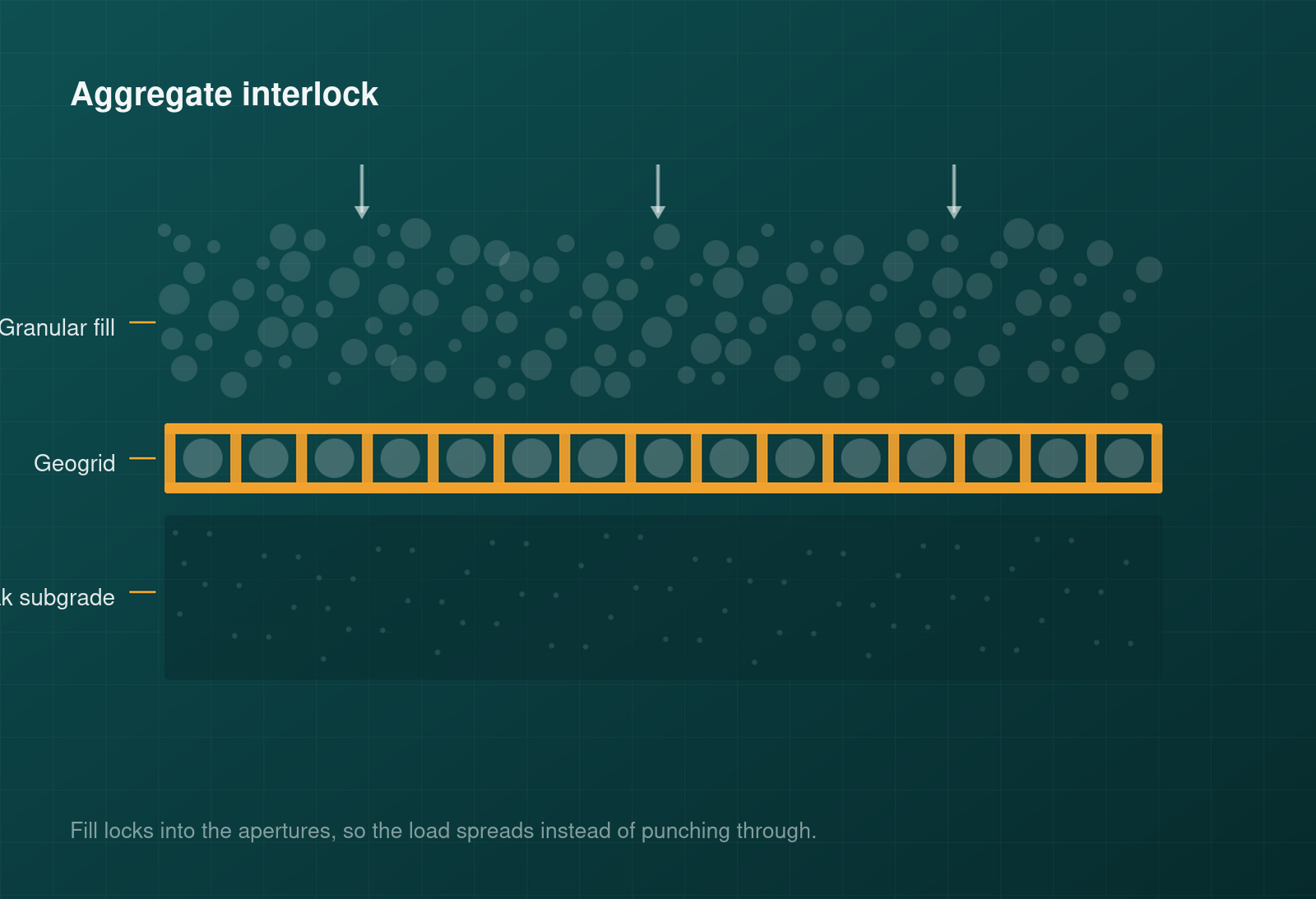
A geogrid works by interlocking with the aggregate pushed through its apertures. The soil cannot move laterally, so the load spreads across a wider area and the effective bearing capacity rises. That mechanism depends on tensile modulus at low strain, not on ultimate breaking strength.
It is why a grid quoted only on its kN/m figure tells you very little. A grid that reaches 100 kN/m at twelve per cent elongation is the wrong product for a pavement that must not settle. Ask for the strength at two and five per cent strain.
- Six grid types covering polymer, fiberglass and basalt construction.
- Tensile strengths from 35x35 kN/m through to 100x100 kN/m.
- Strength at working strain quoted alongside ultimate strength.
Geogrid types we supply
Direction of loading decides the type before anything else does.
PP uniaxial
Strength concentrated in one direction, for retaining walls, steep reinforced slopes and embankments where the load path is known and one-way.
- Single-direction strength
- Retaining walls and slopes
- Polypropylene or HDPE
PP biaxial
Equal strength in both directions, for subgrade stabilisation under roads, yards and working platforms where loading comes from every direction.
- Equal warp and weft strength
- Roads, yards, platforms
- Aperture sized to aggregate
Multiaxial
Triangular aperture geometry giving near-uniform stiffness through 360 degrees, which is what trafficked platforms actually see.
- Radial stiffness
- Heavy trafficked platforms
- Best aggregate interlock
Polyester
PVC-coated polyester yarn, high modulus with low long-term creep. The choice where the reinforcement carries a permanent load for decades.
- PVC-coated PET yarn
- Very low creep
- Permanent load applications
Fiberglass
Very high modulus and negligible elongation, bonded into asphalt overlays to arrest reflective cracking from the layer below.
- Asphalt reinforcement
- Reflective crack control
- Self-adhesive options
Basalt fiber
Similar stiffness to fiberglass with better thermal and chemical durability, used where the asphalt runs hot or the chemistry is aggressive.
- High thermal stability
- Aggressive chemical exposure
- Asphalt and base layers
What the grid does in the ground
Features
- Tensile strength from 35x35 kN/m to 100x100 kN/m.
- High tensile modulus with low elongation at working strain.
- Standard roll width 5 m, lengths from 15 m to 30 m.
- Polypropylene, HDPE, polyester, fiberglass and basalt constructions.
- Aperture geometry matched to the aggregate size on site.
- Uniaxial, biaxial and multiaxial orientations.
Advantages
- Markedly cheaper than a concrete or gabion retaining structure.
- Raises bearing capacity on soft ground without full excavation.
- Cuts aggregate thickness, which cuts haulage and dig.
- Fast to lay with no specialist plant.
- Makes land reclamation viable on ground that would otherwise be rejected.
- Controls differential settlement and sinkhole risk over voids.
Geogrid ordering information
Standard production. Tell us the design strain and we will quote strength at that strain rather than only the ultimate figure.
Product
Uniaxial, biaxial, multiaxial and fibre geogrid
Raw material
PP, HDPE, PVC-coated polyester, fiberglass, basalt fibre
Tensile strength
35×35 kN/m to 100×100 kN/m
Width
5 m standard
Roll length
15 m to 30 m
Orientation
Uniaxial, biaxial, multiaxial
Aperture
Sized to the aggregate on site
Minimum order
By project, quoted on drawings
Packing
Wrapped rolls, palletised
Delivery terms
EXW, FOB, CFR, CPT
Where geogrid is installed
Anywhere the ground will not carry what is being built on it, and digging it out is more expensive than reinforcing it.
- Railway and highway subgrade stabilisation
- Reinforced soil retaining walls
- Steep slope reinforcement and protection
- Airfield and port working platforms
- Embankments over soft or compressible ground
- Asphalt overlay reflective crack control
- Erosion control and sinkhole bridging
- Foundation reinforcement for large bearing areas
Reinforcing weak ground?
Send us the subgrade CBR, the design loading and the layer thicknesses you are working with. We will recommend a grid type and strength class.