
Polystyrene
Rigid, dimensionally stable and one of the easiest thermoplastics to process. Supplied as general purpose, high impact and expandable grades for packaging, appliances and insulation.
Three forms, three very different products
Polystyrene splits cleanly into three commercial forms. GPPS is glass-clear and brittle, used where transparency and rigidity matter. HIPS has rubber dispersed through it, trading clarity for impact strength. EPS arrives as expandable beads and becomes foam on site.
They share a base polymer and almost nothing else in how they are bought or used. We supply all three, and most enquiries are settled by deciding which of the three the application actually needs.
- GPPS for clarity and stiffness, HIPS where the part must survive a drop.
- EPS in a full bead-size range from thin-wall packaging to structural block.
- Food-contact suitable grades available on request.
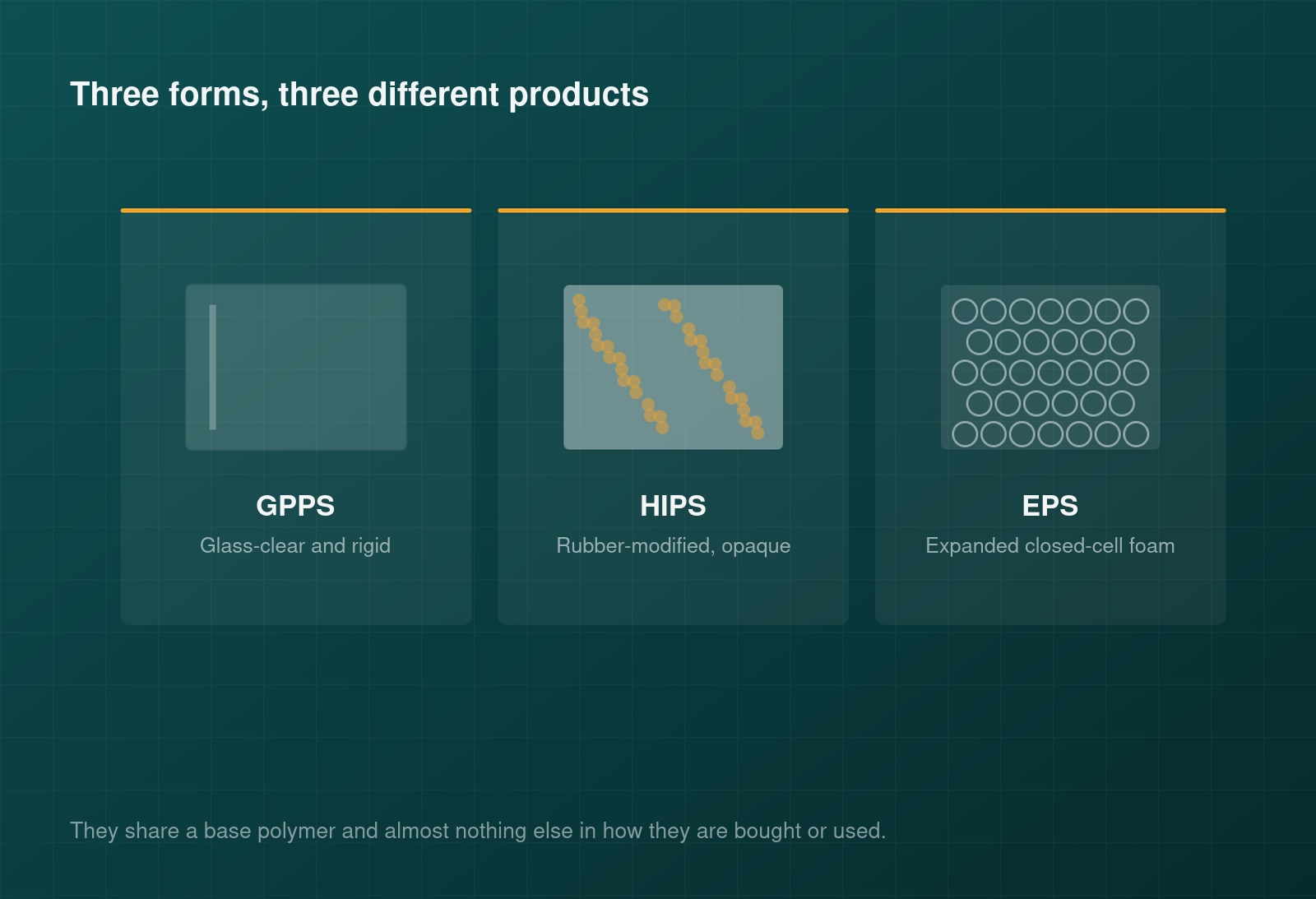
Polystyrene types we supply
Each page lists the complete grade range within that form.
General purpose polystyrene. Glass-clear, hard and dimensionally stable, with excellent flow for thin-wall injection and sheet extrusion.
- Injection moulding grades
- Sheet and thermoforming grades
- High-flow thin-wall grades
Expandable polystyrene. Supplied as impregnated beads that expand into closed-cell foam for insulation, protective packaging and construction block.
- Packaging bead grades
- Construction and insulation block
- Flame-retardant grades
High impact polystyrene. Rubber-modified for toughness, giving an opaque sheet or moulding that resists cracking under impact.
- Sheet extrusion grades
- Refrigeration liner grades
- Injection moulding grades
Where polystyrene is used
Polystyrene earns its place on cost, stiffness and processability. It is rarely the toughest material available, and almost always the easiest to form.
- Disposable cups, trays and cutlery
- Yoghurt pots and dairy packaging
- Appliance and refrigerator liners
- CD cases and clear rigid packaging
- Protective transit packaging
- Insulation board and construction block
- Toys and household mouldings
- Point-of-sale display and signage
GPPS, HIPS or EPS?
Tell us what the part has to survive and how it will be made. The choice between the three is usually obvious once those two things are on the table.